
Render Repair vs Full Re-Render in Essex | How to Know Which You Need
If you are trying to work out whether your property needs a local render repair or a full re-render, the honest answer is that it depends on the condition of the wall as a whole, not just the one area that looks worst.
A lot of homeowners in Essex assume this is mainly a price decision. Repair is cheaper, re-rendering costs more, so repair must be the sensible option. In reality, that only holds true if the issue is genuinely local and the surrounding render is still sound.
At Essex Render Pros, we look at this as a condition decision first. The real question is not just what has failed, but how far the problem spreads, whether the surrounding render is still well bonded, and whether the cause of the defect can actually be dealt with properly.
In this guide, we explain the main signs that a wall may be moving beyond a simple repair, the biggest mistakes homeowners make when deciding between repair and re-rendering, and how we usually assess whether a local repair is still justified.
What Are the Main Signs a Property May Need More Than a Local Render Repair?
The main sign is when the defects stop looking isolated.
A single crack or one damaged area is one thing. But if there is widespread cracking, hollow-sounding render in several places, blown sections, repeated patch repairs that have not really solved the issue, or the elevation looks patchy and tired overall, that usually points to something bigger than a straightforward local repair.
Another warning sign is when the render no longer seems soundly bonded to the wall. If it feels drummy in multiple areas, is visibly coming away, or keeps failing around openings and weak points, we would be much more cautious about treating it as a small local problem.
In simple terms, if the issue is genuinely isolated and the surrounding render is still sound, a local repair may be sensible. If the defects are spread across the elevation or suggest the system is failing more widely, that is when a full re-render starts to become the more realistic conversation.
Key signs to look out for:
- widespread cracking rather than one isolated crack
- hollow or drummy render in several areas
- blown or debonding sections
- repeated patch repairs that do not last
- mixed, tired, inconsistent-looking elevations
- defects around windows, doors, corners, sills, or other weak points
Common Mistakes Homeowners Make About Repair vs Re-Render
One of the biggest mistakes is treating this as a simple cost decision instead of a condition decision.
A repair may be the cheaper option upfront, but that only makes sense if the issue is genuinely local and the rest of the render is still sound.
Another common wrong assumption is focusing only on the visibly damaged area. One crack or one blown patch does not necessarily tell you whether the surrounding render is still well bonded and worth keeping. Sometimes what looks like a small local defect is actually the first visible sign of a wider problem.
We also find that homeowners often expect a local repair to be both technically effective and completely invisible. In reality, repairs can be the right answer structurally without always blending in perfectly on an older, weathered elevation.
At the same time, some people swing too far the other way and assume any cracking means the whole property needs re-rendering. That is not true either. The real question is whether the defect is isolated and repairable, or whether it points to more widespread failure.
In our view, the right decision usually comes down to three things:
- how extensive the defects are
- whether the surrounding render is still sound
- whether the root cause of the failure can actually be dealt with prope
What Do We Look for When Deciding Whether the Surrounding Render Is Still Sound?
When assessing a property, the main thing we are trying to work out is whether the visible damage is genuinely local, or whether it is the first obvious sign of a wider failure.
The clues that make us think a repair may still be justified are when the damage is confined to one section, the surrounding render still feels firm and well bonded, there is no wider pattern of cracking, and the edges around the damaged area are still solid.
What makes us more cautious is when the signs start spreading beyond the obvious defect — hollow or drummy render nearby, cracks running further across the elevation, old repairs failing in the same area, or staining and weakness around openings, corners, or other junctions.
For us, the decision becomes clearer once you stop looking only at the damaged patch and start assessing the confidence you have in the surrounding wall. If the rest of the render still seems sound, repair may be enough. If confidence in the surrounding areas starts dropping, that is when stripping back and starting again becomes a more realistic option.
Real Essex Examples: When Repair Made Sense and When More Extensive Work Was Needed
Real examples help here, because the difference between a repair and a full re-render usually becomes much clearer when you look at the actual condition of the wall.
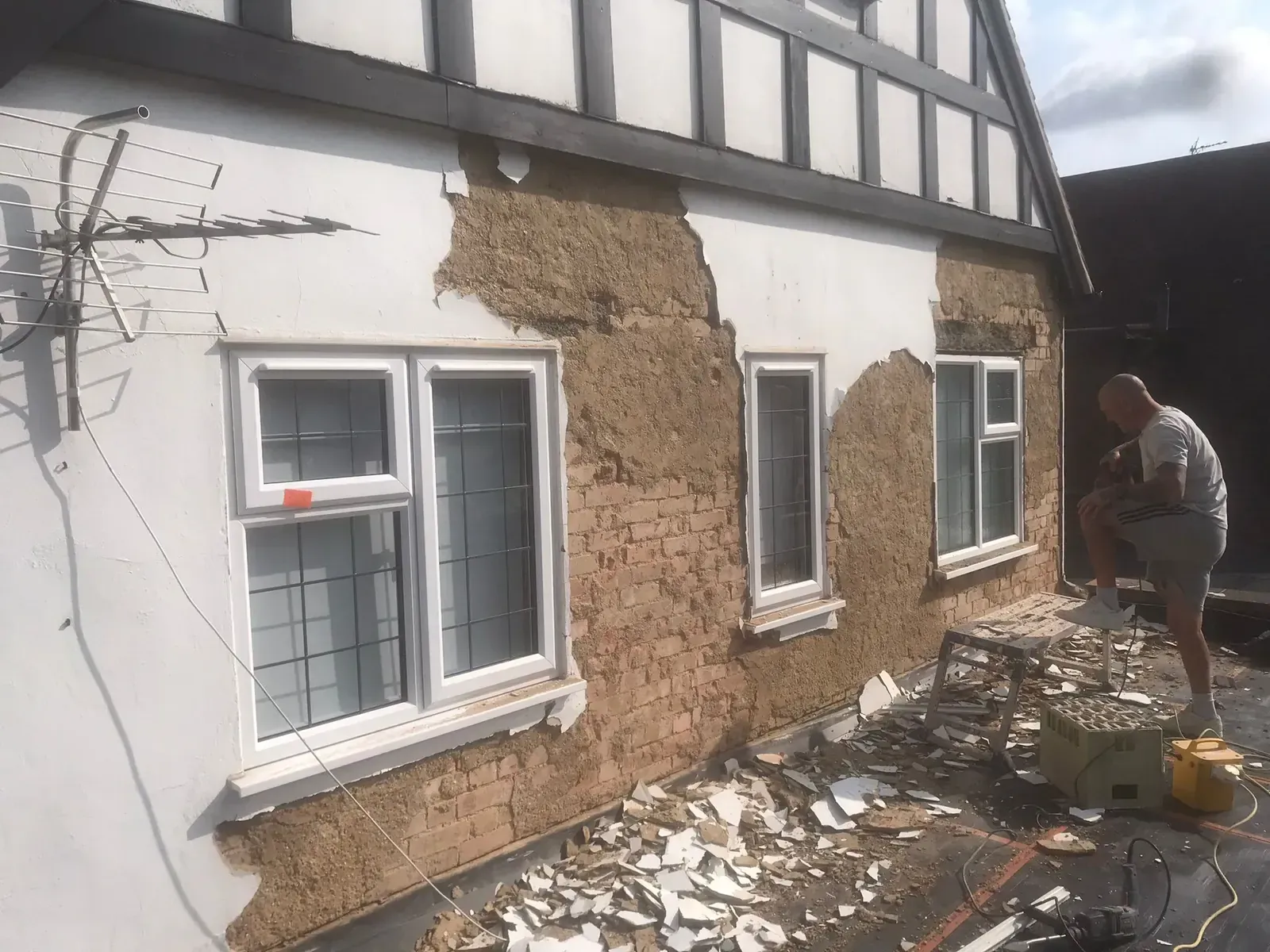
A good example of a more extensive solution is our Great Dunmow project, where the existing render had deteriorated enough that it was not just a case of carrying out a small cosmetic patch. Defective areas needed to be removed, the background needed proper preparation, and the finish needed reinstating in a way that gave the elevation a sounder and more consistent result overall.
By contrast, our Billericay render repair project is a strong example of where a targeted repair was still the honest recommendation. In that case, the blown and crumbled render was removed and rebuilt with a solid sand and cement finish, without unnecessarily turning the whole job into a complete re-render.
For us, that is usually what makes the decision clearer: if the issue is genuinely confined to certain sections and the surrounding render is still sound, repair can make sense. If the defects are more widespread and the finish across the elevation is starting to fail more generally, that is when a fuller re-render becomes the more sensible option.
You can also look at our
recent rendering projects in Essex to see real examples of repair-led work and more extensive re-rendering jobs.
When Is a Render Repair Good Value, and When Does It Become a False Economy?
The honest way we explain it is that a repair is good value when the issue is genuinely local and the surrounding render is still sound. In that situation, there is no sense in stripping back and replacing more than you need to.
Where a repair starts becoming a false economy is when it is only dealing with the visible symptom rather than the wider condition of the wall. If the elevation already has multiple cracks, hollow areas, old failed patches, or a generally tired finish, then the cheaper option upfront can end up costing more over time because the underlying problem is still there.
At the same time, we would never tell a homeowner to pay for a full re-render just because it sounds like the more complete job. If the defect is isolated, the surrounding render is firm, and the cause can be dealt with properly, then a repair can be the more sensible and better-value recommendation.
So for us, the trade-off comes down to this: if the repair is solving a local problem on an otherwise sound wall, it is good value. If it is only buying time on a finish that is already failing more widely, that is when it becomes a false economy.
A repair is usually good value when:
- the defect is isolated
- the surrounding render is firm and well bonded
- there is no wider pattern of hollow or defective areas
- the likely cause can be addressed properly
- the homeowner understands that the goal is a sensible repair, not necessarily a perfectly invisible brand-new-looking elevation
A repair often becomes a false economy when:
- defects are repeating
- the wall has multiple cracks or drummy areas
- old repairs are already failing
- the finish is tired across wider sections
- the real cause has not been dealt with
- money keeps being spent on patches while the wider system continues to deteriorate
If you are also comparing likely budgets, you may find our guide on how much it costs to render a house in Essex useful.
So How Do You Know Which Route Is Right?
In simple terms, the decision becomes much clearer when you stop asking, “How do we fix this one patch?” and start asking, “How sound is the rest of the elevation?”
If the problem is genuinely local and the surrounding render still seems stable, a local repair may be the most sensible and cost-effective answer.
If the wall is showing multiple signs of wider failure, the finish is inconsistent, and confidence in the remaining render is dropping, a full re-render often becomes the more honest long-term recommendation.
The right answer is not always the cheapest one, and it is not always the biggest job either. It is the option that properly fits the condition of the wall.
FAQ: Render Repair vs Full Re-Render in Essex
Is one crack enough to mean I need a full re-render?
No. A single crack does not automatically mean the whole property needs re-rendering. The bigger question is whether the issue is isolated or part of a wider pattern of failure.
Can hollow render be repaired?
Sometimes, yes, if it is genuinely local. But if hollow or drummy areas are spread across wider sections, that is often a sign that the render is failing more generally.
Do render repairs always show afterwards?
Not always, but on older and weathered elevations, an exact invisible match is not always realistic. A repair can still be technically correct even if it does not disappear completely.
When is a full re-render better value?
Usually when the finish is already failing across wider areas, old repairs have not lasted, or patching would only delay the bigger decision.
Is a repair always the cheaper and better option?
Not necessarily. It is cheaper upfront, but it is only better value when the surrounding render is still sound and the repair is actually solving the real problem.
Still have a question?
Need Advice on Whether Your Property Needs Repair or Re-Rendering?
At Essex Render Pros, we do not believe in pushing full re-rendering where a proper repair would do the job.
We look at the condition of the wall properly, assess whether the surrounding render is still sound, and recommend the route that makes the most sense for the property.
So if you are unsure whether your house needs a local render repair or whether the defects point to something more extensive, send over your postcode and a few clear photos and we can give you practical guidance before arranging a site visit.
You can also look through our rendering services in Essex if you want to see the wider types of work we cover.